

FG, US Deepen Security Ties As Washington Endorses Stronger Support For Nigeria by
By our correspondent
The Federal Government’s push for a stronger international security alliance gained significant traction last week as a high-level Nigerian delegation concluded a series of strategic engagements with top officials of the United States Government in Washington, DC.
The meetings, according to a statement signed by Bayo Onanuga, Special Adviser to the President on Information and Strategy, have set the stage for a deeper, more coordinated security partnership aimed at protecting Nigerian citizens amid evolving threats.
Led by the National Security Adviser, Mallam Nuhu Ribadu, the delegation held intensive discussions with officials from the US Congress, the White House Faith Office, the State Department, the National Security Council, and the Department of War. The engagements, described as frank and forward-looking, focused on reinforcing mutual security interests and aligning both nations on strategies to counter terrorism and violent extremism.
A major highlight of the talks was Nigeria’s firm rejection of claims of genocide within its borders. The delegation clarified that violent attacks in the country impact all communities, regardless of faith or ethnicity warning that inaccurate narratives risk deepening divisions and obscuring the complexities of the situation on the ground. Nigerian officials stressed the importance of presenting a factual picture to international partners, noting that mischaracterisations undermine national unity and distract from efforts to safeguard citizens.
Following the series of high-level meetings, the United States Government reaffirmed its readiness to strengthen cooperation with Nigeria across key security fronts. This includes enhanced intelligence sharing, faster processing of Nigeria’s defence equipment requests, and the possible provision of excess defence articles, contingent on availability, to support ongoing military operations against terrorists and violent extremist groups.
Beyond military support, the US also expressed readiness to expand humanitarian and technical assistance, especially for vulnerable populations in the Middle Belt. Washington pledged to work with Nigeria to improve early-warning systems and other stabilisation measures that help protect communities at risk of violence.
Both countries agreed to begin immediate implementation of a new, non-binding cooperation framework designed to guide short- and long-term collaboration. Part of this framework is the creation of a Joint Working Group to drive coordination, track progress, and ensure that both sides remain aligned on shared security priorities.
For its part, the Nigerian delegation reiterated the Federal Government’s commitment to bolstering civilian protection measures and reinforcing systems that enhance the safety of citizens nationwide. Officials noted that these conversations not only corrected misconceptions about Nigeria but also helped build a constructive, solution-focused relationship with the US rooted in trust and mutual respect.
The presidency assured Nigerians that it remains fully aware of the heightened sensitivities around security and religious freedom, and emphasised that decisive, coordinated, and urgent steps are being taken to strengthen national safety architecture.
The delegation to the United States included the Attorney General of the Federation, Prince Lateef Olasunkanmi Fagbemi; Inspector General of Police, Mr. Kayode Egbetokun; Chief of Defence Staff, General Christopher Musa; Chief of Defence Intelligence, Lt. Gen. Emmanuel Parker Undiandeye; Special Adviser to the NSA, Ms. Idayat Hassan; and Director of Foreign Relations at the Office of the NSA, Ambassador Ibrahim Babani.
Gov Aliyu presents new 36-seater Bus to Sokoto United FC
Gov Aliyu presents new 36-seater Bus to Sokoto United FC
By MG Gazali
Sokot
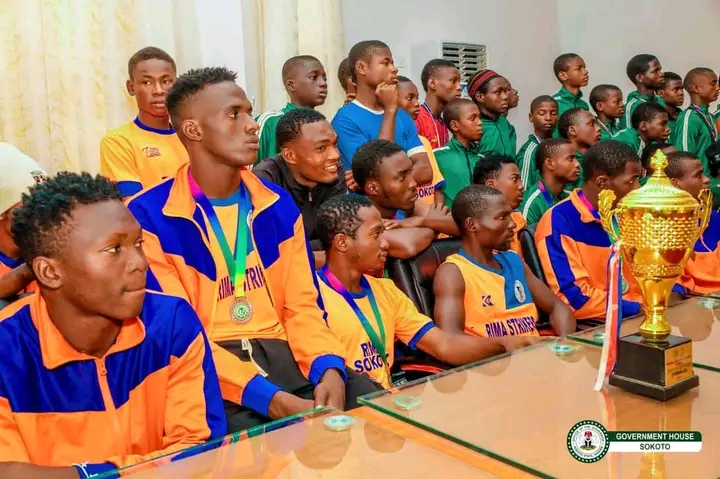
o State Governor, Dr. Ahmed Aliyu, has presented a brand new 36-seater bus to Sokoto United Football Club.
The presentation was made to the State Commissioner of Youth and Sports Development, Engineer Mustapha Muh’d Kofar Marke, at the Government House.
The Governor stated that the State Government is committed to boosting sporting activities and creating a conducive environment for athletes to thrive.
He noted that the brand new bus was to ease the transportation challenges faced by the athletes, which is one of their pressing needs.
The Governor also mentioned that the gesture was in recognition of the outstanding performances made by the Rima Handball team and Rima Football Club, as well as the Sokoto United Football Club, in different competitions.
Dr. Ahmad Aliyu assured the team that the state government would look into all their requests and called on them to make good use of the bus for its durability.
He expressed delight for being able to support the team and emphasized the importance of sports development in the state.
Earlier, the State Commissioner of Youth and Sports Development, Engineer Mustapha Muh’d Kofar Marke, had expressed appreciation for the Governor’s support towards sports development in the state.
He presented various trophies and medals won by Rima Strikers Handball Club, Rima Queens Handball Club, and Sokoto United Football Club in Abia, Lagos, and Ogun States.
The Commissioner also made some requests to the Governor, including the renovation of Giginya Memorial Stadium, provision of training allowances, and other logistics for the clubs.
He emphasized the need for the state government to provide adequate support to the teams to enable them to perform better in future competitions.
The presentation of the bus to the Sokoto United Football Club is seen as a boost to sports development in the state, and the team has expressed gratitude to the Governor for the gesture.
The club’s management has promised to make good use of the bus and ensure that it serves the team for a long time. The gesture is expected to motivate the team to perform better and bring more laurels to the state.
Trump Threatens Nigeria: A Reckless Assault on Sovereignty*
- *Trump Threatens Nigeria: A Reckless Assault on Sovereignty*
fr
Trump Threatens Nigeria: A Reckless Assault On Sovereignty
By Lamara Garba Azare
President Donald Trump’s threat to invade Nigeria over alleged “Christian killings” has sent tremors far beyond diplomatic corridors, revealing a dangerous double standard in global morality. While Washington threatens to brandish the sword in Nigeria, it remains silent or worse, actively complicit over Israeli attacks that have claimed thousands of Palestinian lives, including Christians.
Indeed, this selective outrage by the US is not just hypocrisy; it is a mirror reflecting the perilous dance of power, where might masquerades as right, and morality bends to political expedience.
Therefore, Trump’s words, bolstered by the U.S. House Foreign Affairs Subcommittee’s clearance for punitive steps, are more than empty rhetoric, instead, they are a reckless trumpet call that threatens the sanctity of national sovereignty.
To suggest that the United States could intervene “guns-a-blazing” in a country of over 200 million people is to treat a sovereign nation as if it were a playground for foreign experiments. Nigeria is no pawn, no weakling in need of salvation; it is a proud nation, steeped in history, culture, and resilience. It should be noted that the United Nations Charter is not a parchment of convenience, rather it is a covenant, declaring that no nation may trespass on another without cause or international mandate.
Perhaps, threatening Nigeria flagrantly disregards this moral compass and challenges the very order of the civilized world.
The hypocrisy on display is breathtaking. America professes outrage over alleged “Christian cleansing” in Nigeria while standing shoulder to shoulder with Israel in the bombardment of Palestinian lands, where civilians including men, women, children, and both Muslims as well as Christians have perished under the weight of unrelenting violence. Weapons, funding, and diplomatic shields flow freely, yet when confronted with the plight of ordinary Nigerians facing a web of insecurity, Washington brandishes moral judgment as a cudgel. The moral ledger is unbalanced, the scales tipped not by justice but by political convenience.
If true concern for human life guided America’s hand, it would speak with the same voice for Gaza, the West Bank, Sudan. Yemen, and beyond. Yet Nigeria, a nation grappling with Boko Haram insurgents, bandits, and extremist groups that have taken lives across religious and ethnic lines, becomes the stage for selective indignation. Christians and Muslims alike have bled; the land itself is a witness to centuries of struggle. Conflicts over land, resources, climate pressures, and governance failures intertwine to produce tragedies that cannot be reduced to a single, convenient narrative. To call this merely “Christian cleansing” is to see the world in black and white when it is painted in shades of complexity.
Congressman Chris Smith’s testimony, portraying Nigeria’s crisis as a one-sided religious assault, is a reminder of how stories can be twisted into weapons. Claims that militants act with impunity while the government turns a blind eye ignore ongoing efforts by Nigerian authorities, security agencies, and local communities striving to restore peace.
Oversimplification in the service of foreign political narratives is a sword that cuts both truth and trust, leaving Nigeria exposed to interference and destabilization.
It should be noted that sanctions and threats of military action will not heal wounds; rather, they will deepen them. They will shatter livelihoods, stoke fear, and empower the very extremists they purport to punish.
At the moment, Nigeria needs partners who build, not pawns who strike; guidance, not guns. Long-term collaboration, intelligence-sharing, and governance reforms are the true instruments of peace which are far more potent than the hollow clatter of foreign threats.
Therefore, President Trump’s words cross a red line drawn in the sand of history. Nigeria must rise to defend its sovereignty, calling on ECOWAS, the African Union, and global allies to repel threats cloaked in morality. No nation should be forced to bow to external whims, nor treated as a laboratory for foreign experiments. Pride, history, and destiny demand that Nigeria speak with one voice: sovereignty is non-negotiable.
African nations carry scars from centuries of external meddling from colonial plunder to post-independence interventions disguised as “humanitarian missions.”
Therefore, Nigeria, the giant of Africa, cannot permit the ghosts of history to dictate the present. To threaten invasion while excusing or supporting violence elsewhere is not merely hypocrisy it is moral decay, a reminder that power untempered by principle is a poison to civilization.
Certainly, the United States’ selective advocacy for human rights exposes a philosophical contradiction. Threatening military action in Nigeria under the guise of protecting Christians while remaining silent or complicit in the deaths of Palestinians, including Palestinian Christians, strips its moral authority of legitimacy. Israel’s campaigns in Gaza and the West Bank have claimed countless lives, yet Washington provides shield and sword in equal measure. To pivot that same moral outrage on Nigeria while ignoring these truths is not justice, but it is pretense.
There is no gain saying the fact that Nigeria’s challenges are formidable, but the solution lies within, not in the thunder of foreign boots. Threats, sanctions, and coercion are a windstorm that will uproot communities and spread chaos. What Nigeria needs are bridges of cooperation, pillars of support, and hands extended in partnership, not clenched fists in intimidation. To intervene is to ignite a fire; to assist wisely is to sow lasting peace.
Perhaps, to say the least, Trump’s threats should be seen as reckless and destabilizing, a dangerous echo of a time when force dictated morality and expediency eclipsed principle. In this case, Nigeria must assert its independence, protect its citizens, and insist on respect from foreign powers. Anything less would embolden aggression, invite instability, and send a chilling message across Africa: sovereignty is negotiable, and justice is selective.
The world cannot allow might to masquerade as right. It cannot permit the powerful to choose whose lives matter, whose cries merit attention, and whose suffering is ignored. Nigeria stands at a crossroads: it must defend its dignity, assert its sovereignty, and demand consistency in the moral universe. The time for courage, clarity, and unity is now, lest silence and hesitation embolden those who mistake power for virtue.
Lamara Garba Azare writes from Kano
Inside Tinubu’s Escort Withdrawal Order: How Thousand Of Police Officers Serving VIPs Weakened National Security
By Danjuma Mohammed
President Bola Ahmed Tinubu’s directive to withdraw police escorts from Very Important Persons (VIPs) may appear like a routine administrative action, but an investigation into Nigeria’s security architecture shows it could be one of the most consequential policy shifts in years.
For over a decade, the Nigeria Police Force has struggled with manpower shortages, yet a significant percentage of its operatives are posted not to communities but to politicians, businessmen, clerics, private estate owners, retired officials and even entertainers. Security insiders estimate that between 80,000 and 120,000 police officers, nearly one-third of the entire force are currently attached to VIPs, leaving stations nationwide critically understaffed.
While police stations in some rural communities operate with fewer than five officers, dozens of VIPs move with convoys of up to 20 policemen. Banditry-prone villages in states such as Zamfara, Niger, and Kaduna often have no patrol teams at night, yet top politicians and private individuals have uniformed personnel guarding their residences, escorting their families, and running errands.
It is this imbalance that security officials say prompted President Tinubu’s Sunday meeting with military chiefs, the Inspector General of Police, and the DSS Director-General in Abuja, where he issued what sources described as a “no-exemption directive.”
A senior presidency official familiar with the meeting told this newspaper that the President expressed frustration that Nigeria’s police presence in communities has collapsed, despite billions spent annually on security allowances for escort duties.
The new policy mandates that VIPs requiring protection must now obtain armed operatives from the Nigeria Security and Civil Defence Corps (NSCDC), freeing police officers for core policing duties such as patrols, investigations, intelligence gathering, and rapid response.
The move also coincides with the President’s approval of 30,000 new police recruits, and a separate plan to upgrade training institutions in collaboration with state governments.
Security analysts say the directive could dramatically increase police visibility if implemented faithfully. However, they warn that powerful individuals who have long benefited from privileged police protection might resist compliance, creating a potential enforcement challenge.
“They’ve tried this reform several times in the past, but implementation collapsed because VIPs lobbied their way around it,” a retired police commissioner told this reporter. “The difference now is that the President seems determined to enforce it in the context of nationwide insecurity.”
Another security source noted that redeploying just 20% of VIP-attached officers back to regular duty could double the manpower available for rural patrols and anti-kidnapping operations.
Sunday’s meeting, attended by the Chief of Army Staff Lt. Gen. Waidi Shaibu, Chief of Air Staff Air Marshal Sunday Kelvin Aneke, Police IG Kayode Egbetokun, and DSS DG Tosin Adeola Ajayi, marks the beginning of what insiders describe as a “security recalibration.”
Whether the directive becomes a turning point or another abandoned reform will depend on its execution in the coming weeks.
Tinubu Orders Withdrawal Of Police Escorts From VIPs, Redirects Officers To Core Duties
By Bello Shehu Tamaje
President Bola Ahmed Tinubu has directed the Nigeria Police Force to immediately withdraw personnel assigned as security escorts to Very Important Persons (VIPs) across the country, in a major shake-up aimed at strengthening community policing and restoring manpower to underserved areas.
The directive, issued during a high-level security meeting in Abuja on Sunday, follows concerns over the dwindling number of operational police officers available to protect citizens, especially in remote and high-risk communities.
Under the new policy, VIPs who require official security protection will no longer rely on police escorts. Instead, they will be required to request armed operatives from the Nigeria Security and Civil Defence Corps (NSCDC), according to details from the meeting.
Presidency sources say the President is determined to address long-standing gaps in police response and visibility, as thousands of officers remain attached to individuals rather than performing core policing duties. Many rural settlements currently have only a handful of police personnel some with fewer than five officers, leaving residents vulnerable to banditry, kidnapping, and communal attacks.
President Tinubu has also approved the recruitment of 30,000 additional police officers as part of a broader plan to revitalise the force. The federal government is working with state governments to upgrade training facilities and improve the operational readiness of security agencies nationwide.
Sunday’s meeting was attended by top security chiefs, including the Chief of Army Staff, Lt. Gen. Waidi Shaibu; Chief of Air Staff, Air Marshal Sunday Kelvin Aneke; Inspector General of Police, Kayode Egbetokun; and the Director-General of the Department of State Services, Tosin Adeola Ajayi.
The withdrawal of police escorts, one of the most significant reforms in recent years is expected to take immediate effect, though implementation modalities are still being worked out.
ACF Presents Distinguished Award To Senator Wamakko
November 22, 2025
In a momerable celebration marking its 25th Anniversary, the Arewa Consultative Forum (ACF) presented Senator Aliyu Magatakarda Wamakko (Sarkin Yamman Sokoto) with the Distinguished Service Award during the Silver Jubilee event.

The ceremony took place at the Musa Yar’adua Conference Hall, situated within the Murtala Muhammad Square in Kaduna, drawing a congregation of esteemed personalities and distinguished leaders.
Expressing his gratitude, Senator Wamakko remarked on the significance of the award, stating, “I am deeply honored to be recognized by the ACF with this historic award.
It is a testament to the collective efforts and dedication of many towards the betterment of our society.”
He acknowledged the ACF for its commitment to uplifting and acknowledging those who serve humanity selflessly.
The event not only recognized Senator Wamakko’s contributions but also highlighted the accomplishments of several other notable figures.
Among the many awardees were influential personalities such as Alhaji Aliko Dangote, the Secretary to the Federal Government, Senator George Akume, and General T.Y. Dan Juma, among others.
Their recognition underscored a collective commitment to societal advancement and good governance.
Hon. Ahmad Abdullahi Kalambaina and Hon. Sani Alhaji Yakubu Gudu were among those who congratulated Senator Wamakko during the ceremony.
They emphasized the importance of the award, describing it as timely and inspiring, urging other leaders to strive for recognition through exemplary service to their communities. Abdulrahman Adamu also joined in celebrating Wamakko’s achievements, reinforcing the call for leaders to elevate their service standards.
RECOMMENDED NEWS