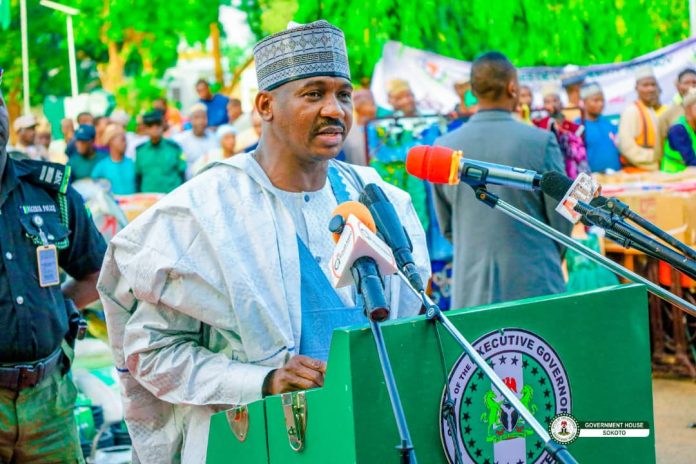
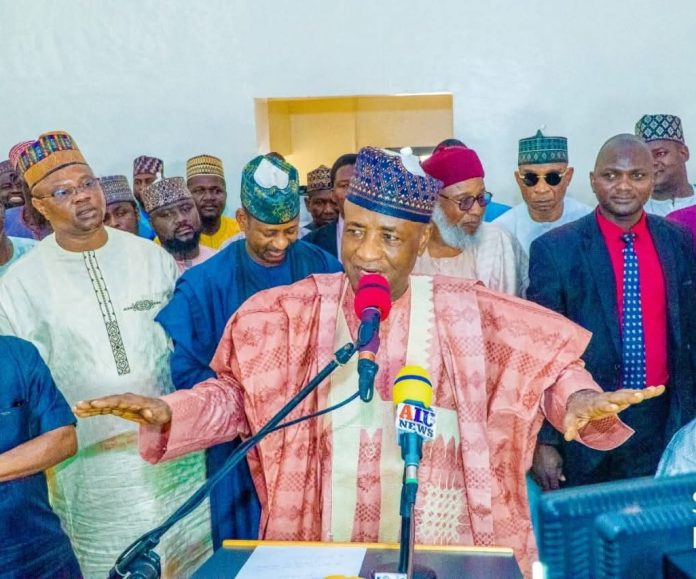
Sokoto State Governor, Ahmed Aliyu, has emphasized the crucial role of responsible journalism in nation-building and urged media practitioners to adhere to professional ethics.
He made this call while delivering his address at the 10th Anniversary celebration of Vision FM Sokoto.
The Governor congratulated the station on reaching this remarkable milestone, describing the station as a strong voice for the people of the state and a reliable partner in the development process.
Governor Aliyu commended them for their commitment to objective reporting, public enlightenment, and promoting social harmony over the past ten years.
He noted that Vision FM has played a significant role in deepening democracy through issue-b
Gov. Ahmed Aliyu of Sokoto state
ased programmes, phone-in segments, and balanced coverage of government activities and public concerns. According to him, in the last Ten years, Vision FM has contributed to promoting government policies, strengthening democracy, and ensuring unity among citizens in the state.
The Governor also praised the management and staff of Vision FM Sokoto for their resilience and innovation in the face of economic and operational challenges affecting the media sector nationwide. He encouraged them to sustain their culture of professionalism, accuracy, and community-focused programming as they begin another decade of service.
He pledged to improve the welfare and working conditions of staff of state-owned media organisations, as part of efforts to motivate them for enhanced professionalism and efficient service delivery.
Aliyu highlighted measures already taken by his administration to reposition the state media industry in line with modern broadcasting standards, including the procurement of two transformers for Rima FM, provision of digital broadcasting equipment, and installation of internet services to boost operational efficiency.
The Governor urged media practitioners to continue to uphold the highest standards of journalism, ethical broadcasting, and public service, assuring that his administration would remain media-friendly and continue to patronise private media organisations operating in the state.
In his remarks at the ceremony,Senator Aliyu Magatakarda Wamakko, a former Governor of Sokoto State and current Senator representing Sokoto North Senatorial District, commended the management and staff of Vision FM Sokoto for their dedication to quality broadcasting and service to the community. He noted that the station has played a significant role in promoting the state’s culture and values, and has been a platform for the people to air their views and opinions.
The Chairman of Vision Media Services, Alhaji Umar Faruk, expressed profound gratitude to the Governor, dignitaries, and the good people of Sokoto, partners, and loyal listeners for their unwavering support to Vision FM over the past decade. He stated that the station was founded on the principles of service, integrity, and the desire to give voice to ordinary citizens, and reaffirmed the station’s commitment to upholding these ideals.
In a massage of Goodwill, former Commissioner for Information in Sokoto State and Director-General of the National Broadcasting Commission (NBC) during the period when Vision FM’s licence was signed, Mal Nasiru Dan Ladi Bako, congratulated the station on its 10th anniversary and commended them for their commitment to quality broadcasting. He noted that he was proud to have played a role in facilitating the establishment of the station and wished them well in their future endeavours.
The highlight of the ceremony was the presentation of awards, with Governor Ahmad Aliyu honoured as Champion of Peace and Harmony, while Senator Aliyu Magatakarda Wamakko received the award of Most Acceptable Politician in Northern Nigeria. Awards were also presented to outstanding staff and partners and listeners of Vision FM Sokoto.
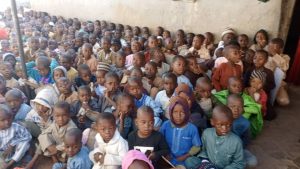
The above phrase was coined by a UK-based non-governmental organization to promote sustainable educational development in Nigeria, aimed at removing vulnerable children, street urchins, and almajirai from the streets and enrolling them in schools. The organization is set to debut in Sokoto State to partner with the government.
There exists a very large army of such children roaming the streets in a hopeless manner that endangers their future. For some time, agencies such as UNICEF and other development partners have expressed deep concern over the growing number of young children who are out of school or have never been enrolled in any form of formal education. This situation continues to pose serious social challenges, despite Nigeria’s concerted efforts to promote sustainable development and inclusive growth.
Over the years, several interventions have been initiated by successive governments and various organizations, but with limited success. These shortcomings have largely been attributed to cultural inhibitions, weak enforcement mechanisms, and inadequate parental guidance.
‘The Boy on the Street’ initiative is therefore being developed with a deliberate focus on ensuring success, having carefully taken into account the shortcomings and policy gaps that undermined previous efforts. The loopholes that once hindered meaningful outcomes have been identified and addressed in order to avoid the pitfalls of the past.
Accordingly, the blueprint for the programme has been made watertight. It integrates both Islamic and Western education, with each modernized to deliver quality instruction that meets societal needs, equips beneficiaries with relevant skills, and promotes productivity and self-reliance.
The programme’s unique attraction lies in its comprehensive approach, which ensures that all children of school age are enrolled, retained, and properly trained, enabling them to become assets to society rather than liabilities with no economic or social value.
The ‘Boy on the Street’ initiative is a comprehensive vision that combines the acquisition of knowledge, moral reorientation, and the assurance of a secure future. It stands as a cardinal objective within Governor Ahmed Aliyu’s 9-Point Smart Agenda and, upon assuming leadership of the state, he left no one in doubt about his priorities by placing education at the forefront of his first budget, with an allocation aligned with international benchmarks.
By embracing this initiative, the government has demonstrated a clear commitment to placing Sokoto on a sustainable trajectory of educational development and growth.”
The extension of the programme to Sokoto adds the State to a growing list of states, such as Borno, Yobe, Adamawa and Edo, where the organization already has a presence and has successfully piloted the initiative. The measurable successes recorded in those states informed and encouraged the Sokoto State Government’s decision to key into the programme.
Already, discussions have been held based on the blueprint unveiled to the state Arabic Education board, which will partner with the organization in implementing the initiative. Schools to be enlisted into the programme both conventional and Islamiya based, have been identified and duly approved.
Under the terms of the memorandum of understanding, expected to be signed soon, the organization will initially run the schools under the supervision of the board, which is expected to understudy the management and administrative processes embedded in the system. At the end of agreed period, the board is expected to fully take over the running of the schools, following several years of direct management by the organization.
Beyond the educational outcomes, the initiative aligns with Governor Ahmed Aliyu’s 9-point smart agenda, particularly its emphasis on human capital development, inclusive education, social reorientation and youth empowerment.
By targeting vulnerable children and moral instruction with formal learning, the programme reflects the administration broader vision of building a secured, enlightened and productive society, one which no child is left behind and the ‘boy on the street’ is transformed into a responsible citizen with a stake in Sokoto State’s future.
Former Governor of Sokoto State and Senator representing Sokoto North Senatorial District, Senator Aliyu Magatakarda Wamakko, has reiterated his strong support for President Bola Ahmed Tinubu, assuring him of continued backing for the President’s policies and programmes ahead of the 2027 general elections.
Senator Wamakko stated this on Friday at the Government House, Sokoto, during the official flag-off of the disbursement of mobilisation funds for the reconstruction of the burnt section of the Sokoto Central Market, awarded to indigenous contractors.
The APC leader stated that President Tinubu has consistently supported state governments by ensuring that their statutory allocations are released promptly and without delay, a move he described as critical to effective governance and development at the sub-national level.
Senator Wamakko further revealed that the Tinubu-led administration has made several federal appointments in favour of Sokoto State, noting that such a level of inclusion and representation has never been witnessed in the political history of the state.
According to him, these gestures reflect the President’s commitment to fairness, inclusiveness, and national unity, stressing the need for the people of Sokoto State to appreciate the efforts of the Federal Government.
He therefore reassured the President of the unflinching support of Sokoto State stakeholders for the policies and programmes of the Tinubu administration, urging citizens to remain steadfast and supportive.
The Senator also used the occasion to commend Governor Ahmad Aliyu for the numerous developmental projects being executed across the state, particularly in infrastructure and economic revitalisation.
He called on the Governor to sustain the momentum, assuring him of the continued support of political leaders and stakeholders in the state.
The event was attended by top government officials, party leaders, traditional rulers, traders, and other stakeholders, who expressed optimism over the reconstruction of the market and the overall direction of governance in the state.
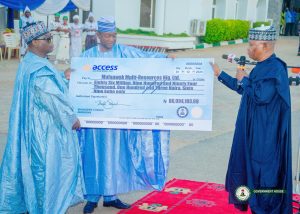
Sokoto State Governor Dr. Ahmed Aliyu has flagged off the disbursement of ₦4.2 billion mobilisation fees to contractors for the reconstruction of the burnt section of the Sokoto Central Market. The project, which was a fulfilment of campaign promise, aims to revitalize the state’s economy and provide relief to affected traders.
During a ceremony to mark the disbursement at the Government House Sokoto, Governor Ahmed Aliyu said, “This project is a testament to our commitment to supporting the business community and promoting economic growth in the state. We are confident that the reconstruction of the burnt section of the Market will have a positive impact on the state’s economy and the livelihoods of its residents.”
He recalled that the Central Market was burnt down in 2021 during the administration of former Governor Aminu Tambuwal. Despite the contract award and donations received, the reconstruction work failed to materialize.
However, he explained that the reconstruction was further delayed due to the need to reclaim the market from Taj Bank, to which it was leased out by the past government. “We had to take steps to reclaim our market, and now that we have done that, we can proceed with the reconstruction,” he said.
He added that the contract for the reconstruction of the market was awarded at the cost of ₦8.4bn to a number of contractors from the state’s business community following mutual consultations and advice, noting that the mobilisation fee represents 50% of the contract sum.
The Commissioner for Lands and Housing, Barrister Nasir Aliyu Dantsoho, expressed delight in the commencement of the market’s reconstruction, noting that it would not only boost economic activities but also enhance the state’s revenue base. “This project is a significant milestone in our administration’s efforts to improve the state’s infrastructure and provide a conducive environment for businesses to thrive,” he said.
Senator Aliyu Magatakarda Wamakko, a former governor of the state, commended Governor Ahmed Aliyu for fulfilling his campaign promise to reconstruct the Sokoto Central Market. He noted that the governor’s determination to restore the economic heartbeat of the state demonstrates leadership focused on people-oriented development and practical solutions to the challenges of traders and small business owners.
Senator Wamakko also recalled his own contributions to the development of the market, saying, “During my time as governor, I constructed 1,750 shops in the market and built the meat and vegetables market. We also secured interest-free loans for businessmen and women in the state, which helped to expand commercial activities and empower thousands of families.”
He expressed gratitude to President Bola Ahmed Tinubu for his sound economic policies, which have increased revenue allocation to the states, and for his unwavering support to Sokoto State. “These policies are creating opportunities for more developmental projects that directly touch the lives of ordinary citizens,” he said.
The contractors also expressed their commitment to delivering a high-quality reconstruction of the market. Malam Nafiu Dan Haja, a representative of the contractors, said, “We are committed to delivering a high-quality reconstruction of the market within the stipulated timeframe. We appreciate the government’s support and look forward to a fruitful partnership.”
Alh Aliyu Arzika, another contractor, commended the governor for his vision and leadership. “We are proud to be part of this project, and we assure the government and the people of Sokoto State that we will deliver a world-class market that will meet the needs of the traders and the entire community,” he said.
The ceremony was witnessed by the Minister of Labour, Dr. Muhammad Maigari, his counterpart the State Minister for Works, Barrister Bello Muhammad Goronyo, former Deputy Governors, Chiso Abdullahi Dattijo and Barrister Muktari Shagari, among others.
The Sokoto State Government has commended the outgoing General Officer Commanding (GOC) of the Nigerian Army’s 8 Division, Major General Ibikunle Ajose, for what it described as outstanding leadership and significant contributions to the fight against banditry and other security challenges across the North-West.
The commendation was given on Wednesday during a send-forth ceremony organised in honour of Major General Ajose and other outgoing senior officers at the Eagle Officers Mess, Giginya Cantonment, Sokoto.
Speaking at the event, the Special Adviser to Governor Ahmed Aliyu on Security, Colonel Ahmed Usman (rtd), who was the special guest at the ceremony, described the outgoing GOC as a gallant and professional officer whose tenure recorded remarkable operational successes.
Colonel Usman particularly highlighted Major General Ajose’s role as Commander, Sector 2 of Operation Fansam Yamma, noting that his strategic leadership, operational discipline and effective coordination with other security agencies significantly weakened the activities and operational capacity of bandits and criminal elements in the region.
According to the Special Adviser, the outgoing GOC demonstrated uncommon commitment, courage and patriotism in the discharge of his responsibilities, earning the respect of officers and men under his command as well as the confidence and appreciation of the civil population.
“The people of Sokoto State and indeed the entire North-West will continue to remember Major General Ibikunle Ajose for his selfless service, operational excellence and firm resolve in confronting banditry and other security threats,” Colonel Usman said.
He added that Ajose’s contributions strengthened inter-agency security collaboration and helped restore public confidence in affected communities.
Colonel Usman also assured the Nigerian Army of the continued support and cooperation of the Sokoto State Government under the leadership of Governor Ahmed Aliyu, stressing the administration’s commitment to sustaining peace and security across the state.
He further reassured residents that the state government remains fully committed to working with the military and other security agencies to consolidate the gains recorded in the fight against insecurity and to safeguard lives and property.
“The government will not relent in providing the necessary support to security agencies, while also engaging communities to ensure lasting peace and stability,” he stated.
The Special Adviser wished Major General Ajose success in his future assignments, noting that his legacy of service, sacrifice and professionalism would continue to inspire serving and upcoming officers of the Nigerian Army.
The Federal Government has taken a significant step towards transforming the country’s livestock sector with the launch of the 2026 Trans-Boundary Animal Diseases Vaccination and the commissioning of the L-PRES Model Veterinary Hospital in Sokoto State.
The Minister of Livestock Development, Hon. Muktari Maiha, flagged off the nationwide livestock vaccination campaign in Sokoto State.
He explained that the initiative would be implemented across all states through trained veterinary teams, adding that the government was committed to ensuring that no community was left behind.
Hon Maiha commended the Sokoto State Government for its collaboration and support to federal livestock programmes. He urged livestock owners to present their animals for vaccination and to cooperate with veterinary officers during the exercise.
The minister expressed delight in commissioning the L-PRES Model Veterinary Hospital, describing it as a state-of-the-art facility that would provide quality veterinary services to farmers and pastoralists.
He urged the hospital’s management and staff to ensure best practices in delivering veterinary services, emphasizing that the hospital should provide quality services that met the needs of farmers and pastoralists.
The Governor of Sokoto State, in his remarks,at the ceremony,expressed gratitude that Sokoto was chosen as the host state for the national flag-off.
He described the programme as timely, coming at a period when livestock diseases had caused significant losses to pastoralists and farmers.
Governor Aliyu,highlighted the state’s efforts to improve animal health services, including the upgrading of veterinary clinics and the recruitment of additional veterinary officers. He assured that the state government would continue to partner with the Federal Ministry of Livestock Development and development agencies to modernize livestock production.
The governor also expressed delight in the commissioning of the L-PRES Model Veterinary Hospital, describing it as a significant milestone in the state’s efforts to improve veterinary services.
He noted that the hospital would provide quality veterinary care to farmers and pastoralists and contribute to the growth and development of the livestock sector.
The Sultan of Sokoto, represented by the District Head of Kilgori, Dr. Muhammad Jabbi Kilgori, expressed his support for the programme and commended the Federal Government for its efforts to improve the livestock sector.
The National Coordinator of L-PRES, Dr. Sanusi Abubakar, expressed gratitude to the Governor and the Federal Government for their support and commitment to developing the livestock sector.
The National Coordinator noted that the L-PRES Model Veterinary Hospital was a key component of the programme, designed to provide quality veterinary services to farmers and pastoralists.
The nationwide vaccination campaign is expected to cover millions of animals and will be accompanied by public sensitization on animal health, biosecurity, and disease reporting.
Stakeholders expressed optimism that the programme would boost meat and milk production, enhance trade, and contribute significantly to national food security.
The L-PRES Model Veterinary Hospital is expected to bring numerous benefits to the state, including improved delivery of veterinary services and increased productivity and competitiveness of the livestock sector. With the flag-off of the 2026 Trans-Boundary Animal Diseases Vaccination, the state is taking a proactive approach to addressing the challenges facing the livestock sector.
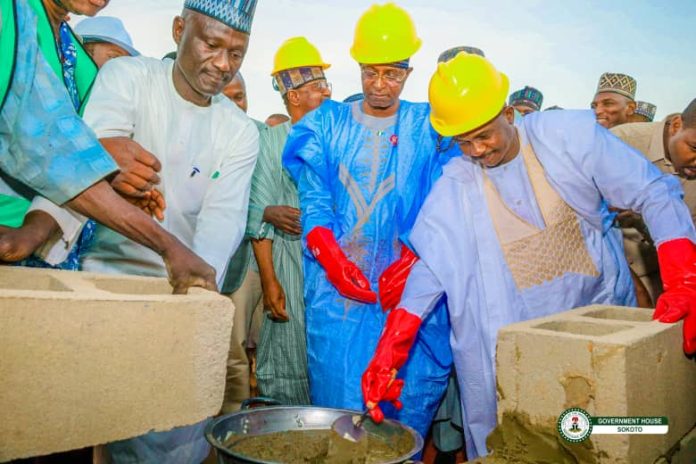
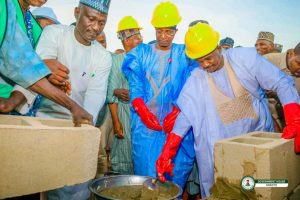
Minister of Livestock Development, Hon. Idi Mukhtar Maihi andGov. Ahmed ALIYU of Sokoto state laying the foundation stone of the service centre
Minister of Livestock Development, Hon. Idi Mukhtar Maihi andGov. Ahmed Aliyu of Sokoto state laying the foundation stone of the service centre
From MG Gazali
The Federal Government of Nigeria has taken a significant step towards transforming the country’s livestock sector and empowering rural communities with the laying of the foundation stone for the Livestock Development Service Centre in Wamakko Local Government Area of Sokoto State.
The Minister of Livestock Development, Honourable Idi Mukhtar Maiha, described the project as a strategic intervention aimed at strengthening veterinary services, improving animal husbandry practices, enhancing productivity, and expanding the livestock value chain across the North-West and beyond.
According to him, the centre will serve as a hub for veterinary care, livestock training, breed improvement services, and youth empowerment, providing vital support to pastoralists and farmers in the region.
Hon Muktari Maiha highlighted the government’s broader efforts to reposition the livestock subsector, align projects with national development plans, and create economic opportunities for rural communities.
He reiterated the Ministry’s ambition to integrate such service centres into a nationwide network that supports commercial livestock systems, combats animal diseases, and fosters sustainable agricultural growth.
The Minister expressed gratitude to the World Bank for their support to the project. “We are grateful for the World Bank’s support to the Livestock Development Programme,” he said. “We look forward to continuing our partnership with the World Bank and other development partners to promote the development of the livestock sector in Nigeria.”
Dr. Muhammad Sanusi, National Coordinator, Livestock Development Programme, commended the Minister for his vision and leadership in driving the livestock development agenda in Nigeria.
“The Livestock Development Service Centre is a critical component of our national livestock development strategy,” he said. “It will provide a platform for livestock farmers and pastoralists to access modern technology, training, and markets, which will improve their productivity and income. We are confident that this project will have a positive impact on the lives of millions of Nigerians who depend on livestock for their livelihoods.”
Sokoto State Governor, Dr. Ahmad Aliyu, in his remarks,welcomed the federal intervention, noting that the Livestock Development Service Centre will complement state-led agricultural reforms and boost food security, job creation, and youth participation in agribusiness across Sokoto communities.
“The project will not only create employment opportunities for our people but also support our pastoralists and boost our state’s economy,” he said.
The Governor also highlighted the state government’s efforts to tackle banditry, which has been a major challenge to livestock production in the state. “We are working tirelessly to ensure the security of our farmers and pastoralists, and we have made significant progress in recent times,” he added.
Governor Aliyu thanked the Federal Government for choosing Sokoto State as the location for the Livestock Development Service Centre, describing the project as a game-changer for the state. “It will provide our livestock farmers and pastoralists with access to modern veterinary services, breeding stock, and training, which will improve their productivity and income,” he said.
“We are committed to working with the Federal Government and other stakeholders to ensure the success of this project and to promote the development of the livestock sector in Sokoto State.”
Local livestock herders and community representatives praised the initiative, expressing optimism that the centre will facilitate access to essential services, improve livestock health outcomes, and open new economic avenues for smallholder farmers.
The project is expected to attract partnerships with private sector players, development agencies, and educational institutions, reinforcing the Federal Government’s push to modernize Nigeria’s livestock industry while addressing longstanding gaps in veterinary infrastructure and training.
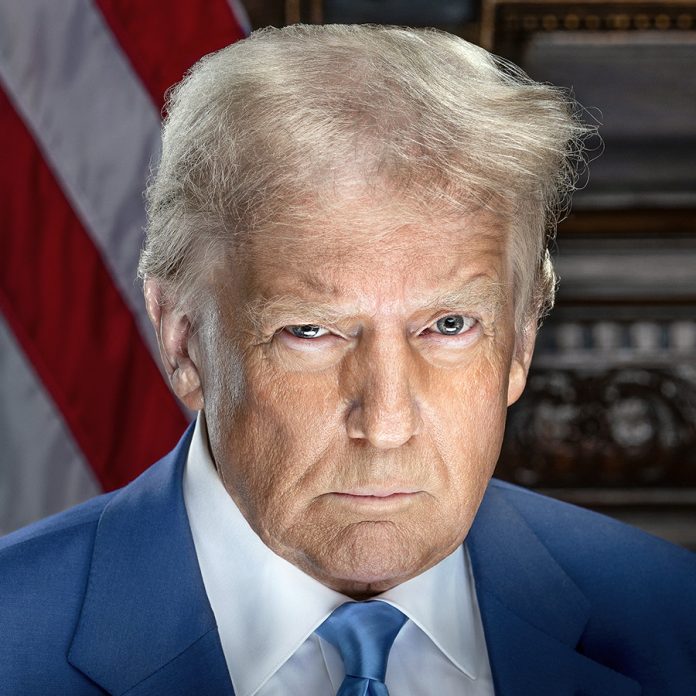
Over the past few months, President Trump has deployed an imposing military force in the Caribbean to threaten Venezuela. Until now, the president used that force — an aircraft carrier, at least seven other warships, scores of aircraft and 15,000 U.S. troops — for illegal attacks on small boats that he claimed were ferrying drugs. On Saturday, Mr. Trump dramatically escalated his campaign by capturing President Nicolás Maduro of Venezuela as part of what he called “a large scale strike” against the country.
Few people will feel any sympathy for Mr. Maduro. He is undemocratic and repressive, and has destabilized the Western Hemisphere in recent years. The United Nations recently issued a report detailing more than a decade of killings, torture, sexual violence and arbitrary detention by henchmen against his political opponents. He stole Venezuela’s presidential election in 2024. He has fueled economic and political disruption throughout the region by instigating an exodus of nearly eight million migrants.
If there is an overriding lesson of American foreign affairs in the past century, however, it is that attempting to oust even the most deplorable regime can make matters worse. The United States spent 20 years failing to create a stable government in Afghanistan and replaced a dictatorship in Libya with a fractured state. The tragic consequences of the 2003 war in Iraq continue to beset America and the Middle East. Perhaps most relevant, the United States has sporadically destabilized Latin American countries, including Chile, Cuba, Guatemala and Nicaragua, by trying to oust a government through force.
Mr. Trump has not yet offered a coherent explanation for his actions in Venezuela. He is pushing our country toward an international crisis without valid reasons. If Mr. Trump wants to argue otherwise, the Constitution spells out what he must do: Go to Congress. Without congressional approval, his actions violate U.S. law.
The nominal rationale for the administration’s military adventurism is to destroy “narco-terrorists.” Governments throughout history have labeled the leaders of rival nations as terrorists, seeking to justify military incursions as policing operations. The claim is particularly ludicrous in this case, given that Venezuela is not a meaningful producer of fentanyl or the other drugs that have dominated the recent epidemic of overdoses in the United States, and the cocaine that it does produce flows mostly to Europe. While Mr. Trump has been attacking Venezuelan boats, he also pardoned Juan Orlando Hernández, who ran a sprawling drug operation when he was president of Honduras from 2014 to 2022.
A more plausible explanation for the attacks on Venezuela may instead be found in Mr. Trump’s recently released National Security Strategy. It claimed the right to dominate Latin America: “After years of neglect, the United States will reassert and enforce the Monroe Doctrine to restore American pre-eminence in the Western Hemisphere.” In what the document called the “Trump Corollary,” the administration vowed to redeploy forces from around the world to the region, stop traffickers on the high seas, use lethal force against migrants and drug runners and potentially base more U.S. troops around the region.
Venezuela has apparently become the first country subject to this latter-day imperialism, and it represents a dangerous and illegal approach to America’s place in the world. By proceeding without any semblance of international legitimacy, valid legal authority or domestic endorsement, Mr. Trump risks providing justification for authoritarians in China, Russia and elsewhere who want to dominate their own neighbors. More immediately, he threatens to replicate the American hubris that led to the invasion of Iraq in 2003.
As a presidential candidate, Mr. Trump seemed to recognize the problems with military overreach. In 2016, he was the rare Republican politician to call out the folly of President George W. Bush’s Iraq war. In 2024, he said: “I’m not going to start a war. I’m going to stop wars.”
He is now abandoning this principle, and he is doing so illegally. The Constitution requires Congress to approve any act of war. Yes, presidents often push the boundaries of this law. But even Mr. Bush sought and received congressional endorsement for his Iraq invasion, and presidents since Mr. Bush have justified their use of drone attacks against terrorist groups and their supporters with a 2001 law that authorized action after the Sept. 11 attacks. Mr. Trump has not even a fig leaf of legal authority for his attacks on Venezuela.
Congressional debates over military action play a crucial democratic role. They check military adventurism by forcing a president to justify his attack plans to the public and requiring members of Congress to tie their own credibility to those plans. For years after the vote on the Iraq war, Democrats who supported Mr. Bush, including Hillary Clinton and John Kerry, paid a political price, while those who criticized the war, like Bernie Sanders and Barack Obama, came to be seen as prophetic.
In the case of Venezuela, a congressional debate would expose the thinness of Mr. Trump’s rationale. His administration has justified his attacks on the small boats by claiming they pose an immediate threat to the United States. But a wide range of legal and military experts reject the claim, and common sense refutes it, too. An attempt to smuggle drugs into the United States — if, in fact, all the boats were doing so — is not an attempt to overthrow the government or defeat its military.
We suspect Mr. Trump has refused to seek congressional approval for his actions partly because he knows that even some Republicans in Congress are deeply skeptical of the direction in which he is leading this country. Already, Senators Rand Paul and Lisa Murkowski and Representatives Don Bacon and Thomas Massie — Republicans all — have backed legislation that would limit Mr. Trump’s military actions against Venezuela.
A second argument against Mr. Trump’s attacks on Venezuela is that they violate international law. By blowing up the small boats that Mr. Trump says are smuggling drugs, he has killed people based on the mere suspicion that they have committed a crime and given them no chance to defend themselves. The Geneva Conventions of 1949 and every subsequent major human rights treaty prohibit such extrajudicial killings. So does U.S. law.
The administration appears to have killed defenseless people. In one attack, the Navy fired a second strike against a hobbled boat, about 40 minutes after the first attack, killing two sailors who were clinging to the boat’s wreckage and appeared to present no threat. As our colleague David French, a former U.S. Army lawyer, has written, “The thing that separates war from murder is the law.”
The legal arguments against Mr. Trump’s actions are the more important ones, but there is also a cold-eyed realist argument. They are not in America’s national security interest. The closest thing to an encouraging analogy is President George H.W. Bush’s invasion of Panama 36 years ago last month, which drove the dictator Manuel Noriega from power and helped set Panama on a path toward democracy. Yet Venezuela is different in important ways. Panama is a much smaller country, and it was a country where American officials and troops had operated for decades because of the Panama Canal.
The potential for chaos in Venezuela seems much greater. Despite Mr. Maduro’s capture, the generals who have enabled his regime will not suddenly vanish. Nor are they likely to hand power to María Corina Machado, the opposition figure whose movement appears to have won the country’s most recent election and who accepted the Nobel Peace Prize last month.
Among the possible bad outcomes are a surge in violence by the left-wing Colombian military group the ELN, which has a foothold in Venezuela’s western area, or by the paramilitary groups known as “colectivos” that have operated on the periphery of power under the Maduro dictatorship. Further unrest in Venezuela could unsettle global energy and food markets and drive more migrants throughout the hemisphere.
So how should the United States deal with the continuing problem that Venezuela poses to the region and America’s interests? We share the hopes of desperate Venezuelans, some of whom have made a case for intervention. But there are no easy answers. By now, the world should understand the risks of regime change.
We will hold out hope that the current crisis will end less badly than we expect. We fear that the result of Mr. Trump’s adventurism is increased suffering for Venezuelans, rising regional instability and lasting damage for America’s interests around the world. We know that Mr. Trump’s warmongering violates the law.
Sokoto State indigenes shortlisted for Army recruitment have been urged to be disciplined and loyal throughout the training exercise.
Governor Ahmed Aliyu Sokoto made the appeal while addressing the candidates at Giginya Barracks, Sokoto.
Alhaji Ahmed Aliyu said this would enable them to emerge victorious at the end of the exercise.
He stressed the need for them to bear in mind that the profession they have voluntarily chosen requires patriotism and sacrifice in the struggle to defend the territorial integrity of the nation.
He used the opportunity to commend President Bola Ahmed Tinubu for approving massive Army recruitment nationwide.
According to him, this would go a long way in strengthening the nation’s Army and helping to address the challenges of insecurity facing the country.
Represented by his Deputy, Alhaji Idris Mohammed Gobir, the Governor announced that the state government has shouldered the responsibility of transporting the candidates to their respective training camps in Zaria, Osogbo, Abakaliki, and Jaji.
He also announced the donation of ₦30,000 to each candidate as pocket money.
The Deputy Governor was accompanied on the visit by the Secretary to the State Government, Alhaji Muhammad Bello Sifawa; Special Adviser on Establishment Matters, Alhaji Garba Bello Kebbe; and the Permanent Secretary, Careers and Special Services, Alhaji Aminu Bello.
Senator Aliyu Magatakarda Wamakko (Sarkin Yamman Sokoto) has described unity as a critical tool for achieving sustainable development in any society, urging professional associations to remain cohesive in the pursuit of progress.
The Senator made the remarks while speaking at the annual conference of the Association of Tipper Operators in Sokoto State, held at the Sultan Muhammadu Maccido Institute for Qur’an and General Studies, Sokoto.
Senator Wamakko, who served as father of the occasion and Grand patron of the Association, commended the Association for maintaining sustained unity over the years, describing it as a model worthy of emulation by other groups.
He assured members that their messages would be conveyed to the Governor of Sokoto State, Ahmed Aliyu Sokoto.
He noted that Governor Ahmed Aliyu has made significant strides in improving road infrastructure across the state and continues to intensify efforts to ensure quality road networks in both urban and rural areas.
The former Governor of Sokoto State also praised the Association for its culture of compassion and responsibility, particularly for remembering its deceased members, supporting their families, and training new drivers to promote professionalism and self-reliance within the sector.
Senator Wamakko further advised tipper drivers in the state to always uphold trust and integrity, especially when vehicles are entrusted to them for commercial purposes, stressing that honesty remains vital to sustaining public confidence in their operations.
In his support for the Association, Senator Wamakko announced a personal donation of 150 bags of 50-kilogram rice, 200 bags of Maize, and cash assistance for onward distribution to members of the Association.
He also called on the National Union of Road Transport Workers (NURTW), the Sokoto Traders Association, and other relevant bodies to emulate the unity and welfare-driven initiatives of the Association of Tipper Operators for the overall development of Sokoto State.