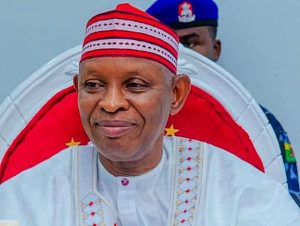
Sokoto State Governor, Dr. Ahmed Aliyu, has directed the State Pilgrims Welfare Agency (PWA) to introduce necessary reforms aimed at ensuring a successful and hitch-free Hajj operation in subsequent years.
The Governor gave the directive while receiving the report of the 2025 Hajj Delegation at the Government House in Sokoto.
Governor Aliyu commended the leader and members of the delegation for their hard work and dedication, which he said contributed to the successful conduct of the 2025 Hajj exercise.
He also appreciated the efforts of the State Pilgrims Welfare Agency and local government Hajj registration officers for their commitment to duty and effective coordination throughout the operation.
Describing the report as comprehensive and insightful, the Governor assured that his administration would carefully study its contents with a view to implementing practical and workable recommendations.
He reaffirmed his administration’s commitment to prioritising the welfare, safety, and comfort of pilgrims, stressing that continuous improvement in Hajj operations remains a key priority of his government.
Earlier, the Leader of the Delegation and Chairman of the Committee, Umaru Kwabo AA, who was represented by the Majority Leader of the Sokoto State House of Assembly,
Hon. Bello Idris, explained that the committee was constituted to oversee, coordinate, and monitor the welfare and activities of Sokoto State pilgrims during the 2025 Hajj exercise, both at home and in the Kingdom of Saudi Arabia.
He noted that the report contains detailed observations from the exercise, challenges encountered, and practical recommendations for subsequent Hajj operations.
According to him, the recommendations focus on improving planning, pilgrims’ welfare, accommodation, transportation, medical services, and overall coordination to ensure a smoother and more efficient Hajj experience.
Umaru Kwabo AA commended the Sokoto State Government for its timely support and cooperation, which he said contributed significantly to the overall success of the 2025 Hajj exercise.
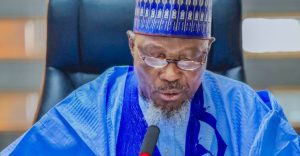
The Chairman/CEO of the National Hajj Commission of Nigeria, Professor Abdullahi Saleh Usman, said the Commission has concluded accommodation arrangements for the 2026 Hajj in both Makkah and Madinah, ahead of the deadlines set by Saudi authorities.
The conclusion of the accommodation uploads and approval/acceptance by the Saudi ministry of Hajj is in line with the directive of the Vice President of the Federal Republic of Nigeria, His Excellency Kashim Shettima, GCON, that all critical Hajj arrangements should be finalised within approved Saudi timelines to safeguard Nigeria’s operational interests.
Professor Abdullahi Saleh Usman acknowledges the guidance and support of the Vice President throughout the process and noted the role played by the high-level delegation sent to Saudi Arabia, the NAHCON Board, the Nusuk Masar team, the leadership of the Forum of State Pilgrims Welfare Boards, NAHCON staff and relevant stakeholders involved in the accommodation process.
With the conclusion of these arrangements, Nigeria has secured its accommodation for the 2026 Hajj and is positioned among countries that have completed this critical requirement within the prescribed timelines.
A statement signed by Ahmad Mu’azu, technical assistant media to the Chairman of NAHCON said the Commission now proceeds to the next phase of operational preparations for the 2026 Hajj.
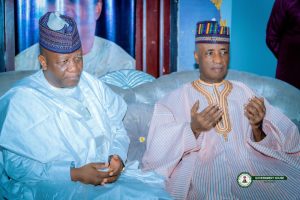
Senator Abdulaziz Yari, former Governor of Zamfara State, has condoled with Senator Aliyu Magatakarda Wamakko over the death of his security aide, Sani Dangwaggo.
During the condolence visit, Senator Yari described the late Dangwaggo as a loyal, disciplined, and dedicated aide whose commitment to duty would be deeply missed.
He prayed that Allah (SWT) grants the deceased eternal rest and gives Senator Wamakko, his family, and associates the fortitude to bear the loss.
Senator Yari was received and accompanied to the residence of Senator Wamakko by the Governor of Sokoto State, Dr. Ahmed Aliyu.
Responding, Senator Wamakko expressed deep appreciation to Senator Yari and his entourage for the condolence visit and the show of solidarity during the moment of grief.
He described the death of Sani Dangwaggo as a painful loss, noting that the late aide was disciplined, committed, and devoted to his responsibilities.
Senator Wamakko prayed that Allah (SWT) forgives the shortcomings of the deceased and grants him Aljannatul Firdaus.
Special prayers for the repose of the soul of the deceased were offered by Malam Bashir Gidan Kanawa.
The Chairman/CEO, National Hajj Commission of Nigeria (NAHCON), Professor Abdullahi Saleh Usman, has assured stakeholders in the Nigerian Hajj industry and intending pilgrims to this year’s pilgrimage in Saudi Arabia that the commission remains focused on delivering exceptional and hitch-free 2026 Hajj.
He stated that to achieve this the commission was strengthening its systems, improving planning, discipline and enhancing professionalism across all aspects of Hajj management, in line with international best practices.
The NAHCON boss further reaffirmed the commission’s commitment to early planning, effective institutional coordination, and strict adherence to established procedures for this year’s Hajj exercise.
A release signed by the Technical Assistant (Media) to the Chairman/CEO, Ahmad Muazu, on behalf of the chairman, made available to Solidnews online stated that NAHCON remained fully aligned with President Bola Ahmed Tinubu-led administration’s policy direction with its Renewed Hope Agenda which prioritised welfare and spiritual well-being of Nigerian pilgrims.
Usman added that NAHCON, which is operating under the supervision of the Vice-President, Senator Kashim Shettima, emphasises timely completion of all critical Hajj preparatory activities.
He noted that priority is being accorded to the early conclusion of state pilgrims’ accommodation arrangements in Makkah, Saudi Arabia, in compliance with the Saudi regulatory timelines for the 2026 Hajj.
It further stated that in alignment with strategic organisational priorities, the NAHCON CEO had authorised the immediate deployment of a high level executive delegation to the Saudi Arabia.
“The delegation, led by the Chairman/CEO, will provide executive oversight, finalise and take over all pending accommodation arrangements in Makkah, ensuring full compliance with Saudi regulatory timelines and mitigating potential operational delays,” he stated.
The delegation will comprise the Commissioner, Planning, Research, Statistics, Information and Library Services (PRSILS), Professor Abubakar A. Yagawal; board members representing North-West, South-West and South-Easr zones, Sheikh Muhammad Bin Uthman; Dr. Tajudeen Oladejo and Hajiya Aishat Obi Ahmed, respectively and Secretary to the Commission, Dr Mustapha Mohammed Ali.
The delegation, according to the release, was mandated to conclude all accommodation arrangements and submit a comprehensive report to the Commission immediately upon completion of the assignment.
It added that in view of the forthcoming visit of Saudi Arabia’s Minister of Hajj and Umrah, Dr Tawfiq Al-Rabiah, to Nigeria this month, Professor Usman will not join the delegation on the trio to Saudi Arabia as he will remain in Nigeria to receive visiting minister, while coordinating the delegation’s activities.
Meanwhile, Usman assured that NAHCON has activated appropriate internal governance, coordination, and oversight mechanisms to ensure accountability, procedural compliance and effective execution of all preparatory activities.
“This includes sustained engagement with board members, senior management, service providers and relevant Saudi authorities to ensure adherence to approved timelines and applicable Saudi regulations,” Muazu stated.
According to the chairman’s media aide, Usman emphasized that all actions undertaken by the commission derive from its statutory mandate as the regulatory body for Hajj in Nigeria.
“Decisions of the Commission, the chairman noted, are institutional, guided by due process, collective, not individual decisions, and the obligation to safeguard the interests of Nigerian pilgrims while preserving Nigeria’s long-standing bilateral relationship with the Kingdom of Saudi Arabia.
“The Chairman assured stakeholders and intending pilgrims that NAHCON remains focused on delivering exceptional and hitch free 2026 Hajj by strengthening its systems, improving planning, discipline, and enhancing professionalism across all aspects of Hajj management, in line with international best practices.
“He further stated that the Commission will continue to issue official updates through its established communication channels as preparations for the 2026 Hajj progress,” Muazu further stated.
Professor Abdullahi Saleh Usman widely known by his nickname “Pakistan” stepped into the spotlight of public service when he was appointed Chairman/CEO of the National Hajj Commission of Nigeria (NAHCON) in August 2024 by President Bola Ahmed Tinubu, and later confirmed by the Senate.
He is a respected Islamic scholar educated at leading institutions including the University of Madinah and Peshawar University, Pakistan, and previously led the Kano State Pilgrims’ Board.
From the outset, his mandate was clear: to modernise and run Nigeria’s Hajj operations with transparency and efficiency, ensuring that Nigerian pilgrims perform their spiritual obligation with dignity.
However, recent months have seen his name become one of the most discussed and contested in Nigeria’s public administration.
The Smear Claims vs. Genuine Concerns
Supporters of Professor Pakistan have consistently described the barrage of negative reporting and criticism as a “smear campaign” one allegedly sponsored by political interests opposed to the current administration’s agenda.
Proponents argue that these attacks are aimed at undermining his growing public reputation and, they claim that critics are merely peddling unverified narratives to distract from his achievements in reforming Hajj processes and reducing pilgrim costs.
Conversely, several credible sources paint a different picture not of conspiracy alone, but of serious administrative and governance issues within the Commission itself.
Internal Rift and Vote of
No Confidence
Late January 2026, members of the NAHCON Board delivered an unprecedented blow: they formally petitioned President Tinubu and issued a collective vote of no confidence on Professor Pakistan.
According to board members, the Chairman’s leadership has been marked by financial indiscipline, procurement law violations, and administrative breakdowns that have compromised not only internal coherence but also Nigeria’s diplomatic standing with Saudi authorities.
Among their concerns were alleged expenditures without board approval and contracts awarded outside proper budgetary and legal frameworks actions they say risked operational dysfunction and harmed Nigeria’s Hajj quota negotiations.
Corruption Probes and EFCC Investigations
Adding to the tension are ongoing investigations by Nigeria’s anti-graft agency, the Economic and Financial Crimes Commission (EFCC).
Recent reports indicate that senior NAHCON officials, including the Commissioner of Policy and Finance and the Director of Finance, were detained and questioned over alleged misconduct and mismanagement involving over ₦50 billion linked to the 2025 Hajj cycle.
These probes were said to include diversion of funds connected to services and logistics a serious matter that casts a shadow over NAHCON’s leadership under Professor Pakistan.
Although the Chairman himself has not been charged, sources suggest that the anti-corruption scrutiny reflects deeper governance issues within the Commission raising questions about oversight, accountability, and internal control mechanisms.
Media Battles and Official Denials
In late 2025, NAHCON’s media office issued a strong denial of a specific online report that alleged the Chairman used state security agencies against journalists and was involved in corruption.
The Commission described the article as “reckless” and entirely fabricated, reiterating that the Chairman neither ordered detentions nor used the Department of State Services to intimidate the press.
NAHCON also challenged the publication to provide credible evidence for its claims.
This public pushback highlights the growing battle for narrative control between media organisations and critics asserting misconduct, and the Commission defending its reputation and insisting on fair reporting standards.
So Who Is Afraid of Pakistan?
At face value, the question captures a larger struggle playing out in Nigeria’s public sphere:
Are the attacks driven by genuine concerns over accountability and governance in a commission handling sensitive religious affairs?
Or are they manufactured controversies by political opponents threatened by a bold reformer?
The truth likely includes elements of both. Professor Abdullahi Saleh Usman Pakistan is a figure of international engagement, complex administrative responsibilities, and intense public scrutiny.
In a post-Hajj environment marked by financial pressures, legal requirements, and heightened expectations from pilgrims and stakeholders alike, his leadership is under both institutional and societal microscopes.
To answer who is afraid of Pakistan may well be to ask whether the critics whether inside politics, media, or governance circles fear transparency, reform, or accountability being brought to one of Nigeria’s most treasured national services. Or whether they fear a leader unafraid to confront systemic issues, even at the cost of internal resistance.
What is undeniable is that this debate has thrust NAHCON and its leadership into the foreground prompting Nigerians to ask not only about the future of the Hajj Commission but about the nature of public leadership itself.
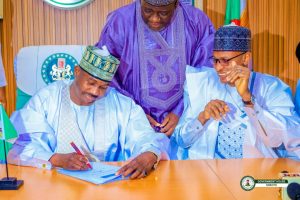
Sokoto State Governor Ahmed Aliyu Signing 2026 Budget
By Sani Umar
Budgeting is an annual exercise undertaken by governments to guide the administration of public resources and the affairs of the people. The process determines how citizens’ aspirations can be addressed and what is required in terms of expenditure. Consequently, this annual exercise is as important as governance itself.
Public budgets are therefore more than financial documents; they are statements of intent. In Sokoto State, recent budget priorities offer insight into a governance philosophy that places fiscal discipline alongside development goals. By examining how resources are allocated across key sectors, a clearer picture emerges of what the government considers foundational to long term stability and growth.
A defining feature of the state’s budgeting approach is the emphasis on planning before spending. Rather than spreading resources thinly, allocations are guided by identified needs and policy objectives. This method reflects an attempt to align expenditure with outcomes, ensuring that projects are not only initiated but also sustained within available means.
Another notable dimension of Sokoto State’s budgeting process is its emphasis on inclusivity and public engagement. Budget preparation is increasingly informed by consultations with community leaders, professional groups, civil society organisations, and other stakeholders across the state. These interactions provide a platform for citizens to articulate local needs and priorities, ensuring that the final budget reflects lived realities rather than assumptions made from the centre.
By incorporating feedback from these engagements, the budget becomes a mirror of collective aspirations. Community driven inputs help shape allocations to sectors such as rural infrastructure, education, healthcare, and social welfare, reinforcing a sense of ownership among the populace. This participatory approach not only strengthens trust between the government and the governed but also enhances accountability, as citizens are better positioned to track how agreed priorities translate into action.
Education continues to command a central place in the budget framework. Investments in schools, teacher recruitment, and learning infrastructure signal an understanding that human capital development underpins economic and social progress. While education often competes with more immediate demands, its consistent prioritisation suggests a long-term view that values skills, literacy, and civic development.
Infrastructure follows closely, absorbing a significant share of capital expenditure. Roads, urban renewal projects, and public facilities are treated as enablers of commerce and service delivery. Compared with recurrent spending, infrastructure allocations point to a preference for assets that can stimulate economic activity and improve access to markets, healthcare, and education.
Security spending reflects prevailing realities in the North-west region. Allocations to security agencies, logistics, and community safety initiatives indicate an effort to safeguard lives and property. While security budgets do not always yield visible structures, their inclusion underscores the belief that development cannot thrive without stability.
Social welfare programmes also feature prominently, though often with more targeted allocations. Support for vulnerable groups, including widows, the elderly, and low income households, demonstrates a balancing act between growth oriented spending and social protection. These interventions, while modest compared to capital heavy sectors, serve as buffers against economic shocks.
Healthcare occupies a strategic middle ground in the budget hierarchy. Funding for hospitals, primary healthcare centres, and medical personnel reflects an acknowledgment that public health is both a social service and an economic necessity. Preventive care and facility upgrades are treated as cost saving measures over time, reducing the burden of advanced illness.
Notably, the distribution of funds across sectors suggests an effort to avoid over concentration. No single sector dominates to the exclusion of others; instead, allocations indicate a calibrated approach that weighs urgency, impact, and sustainability. This balance is critical in a resource constrained environment where trade offs are inevitable.
Beyond sectoral figures, the budgeting process itself speaks to governance values. Scrutiny, prioritisation, and adherence to available revenue are presented as safeguards against fiscal excess. By aligning ambitions with realistic funding, the state seeks to minimise debt exposure while maintaining development momentum.
Ultimately, Sokoto State’s budget priorities reveal a governance philosophy anchored in discipline, inclusivity, and pragmatism. Education, infrastructure, security, healthcare, and social welfare are treated not as isolated silos but as interconnected drivers of development. In this balance lies the broader lesson, that responsible budgeting is not merely about numbers, but about choices shaped by the collective will that define the state’s present and future.
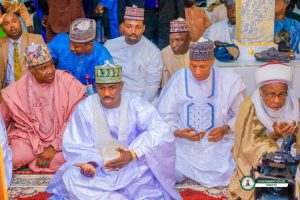
Gov. Aliyu and entourage praying in the newly renovated Izala Mosque in Kebbe
From MG Gazali
Sokoto State Governor, Dr. Ahmed Aliyu, has called on Muslim worshippers across the state to always maintain cleanliness and tidiness in the newly remodelled mosques.
The Governor made the appeal during the commissioning of the Izala Jumu’at Mosque in Kebbe town, Kebbe Local Government Area of the state.
He explained that the decision to renovate Jumu’at mosques across the state was necessitated by the dilapidated condition of most mosques before the advent of his administration.
“When we took over the affairs of this state, most of our Jumu’at mosques were in a state of disrepair. This informed our decision to renovate them and make them more conducive for worshippers,” Governor Aliyu said.
He added that, from the inception of his administration to date, thirty-one Jumu’at mosques have been completed and commissioned across the state.
The Governor reaffirmed his administration’s commitment to providing religious and other critical infrastructure to enhance the well-being of the people.
Speaking at the event, the Special Guest of Honour, Alhaji Yusha’u Kebbe, who commissioned the Kebbe Izala Jumu’at Mosque, commended Governor Aliyu for the numerous people-oriented projects being executed across the state. He particularly praised the remodelling of religious infrastructure, noting that it would create a more conducive environment for worshippers.
Representing the Sultan of Sokoto, His Eminence Sultan Muhammad Sa’ad Abubakar III, the Wazirin Sokoto, Prof. Sambo Wali Junaid, urged worshippers to use the mosque strictly for its intended purpose.
He assured Governor Aliyu of the Sultanate Council’s continued support for the administration’s efforts to improve the living conditions of the state’s people.
The Commissioner for Religious Affairs, Jibir Sani Maihulla, disclosed that several other Jumu’at mosques have also been renovated and are awaiting commissioning.
Chairman of Kebbe Local Government Area, Musa Garba Kuchi, commended Governor Aliyu for the developmental projects in the area and assured him of the people’s unwavering support for his administration.
The Chief Imam of the remodelled Izala Jumu’at Mosque, Sheikh Abubakar Muhammad, later led the two-rak’ah congregational prayers.
Sokoto State Governor, Dr. Ahmed Aliyu, has directed the contractor handling the construction of a retaining wall,the rehabilitation of 2 bridges and a damaged section of the Margai–Kebbe Road to expedite work or risk revocation of the contract.
The Governor issued the directive during an inspection visit to the project site, expressing concern over the slow pace of work despite the road’s strategic importance to commercial activities and the movement of goods and services in the area.
“I am worried about the slow pace of this project, considering its importance to commerce and transportation,” Governor Aliyu said.
While commending the quality of work executed so far, the Governor urged the contractor to deploy additional manpower and equipment to ensure the project is completed within the agreed timeline.
He stressed that the road serves as a major commercial and transportation artery in the state, warning that the government would not tolerate further delays.
Earlier, while briefing the Governor, the Deputy Governor and Commissioner for Works, Engineer Idris Muhammad Gobir, disclosed that the contract was awarded in 2024 with a six-month completion period.
He explained that although 50 per cent of the contract sum had been released as mobilisation, the contractor had not progressed beyond 50 per cent completion of the project.
The Governor was accompanied on the inspection visit by the Speaker of the Sokoto State House of Assembly, Hon. Tukur Bala Bodinga; the Secretary to the State Government (SSG); commissioners; special advisers; local government chairmen; and other top government officials.
In every political season, there emerges a figure whose actions rise above personal pride and partisan noise, a figure who understands that power is not merely about holding office but about healing fractures. In Kano today, that figure is Abba Kabir Yusuf. His return to the All Progressives Congress is not a retreat, nor is it a surrender. It is an act of political wisdom. In the language of the streets and the conscience of the people, it is the Game Changer, the unifier of divided paths.
Politics in Kano has never been a gentle affair. It is deeply emotional, fiercely ideological, and rooted in history. Over the years, loyalties hardened, camps solidified, and disagreements took on a life of their own. In such an atmosphere, it takes uncommon courage to choose reunion over resentment. Abba Kabir Yusuf has chosen the harder path. He has chosen the path that prioritizes Kano over camps, the people over pride, and the future over old wounds.
His rejoining of the APC must therefore be understood beyond the narrow lens of party movement. It is a statement that Kano can no longer afford endless political hostility. It is a recognition that governance thrives not in isolation but in cooperation. It is a belief that leadership is at its finest when it brings people together, even those who once stood on opposite sides.
For Kano and its people, this reunion is a blessing in clear and practical terms. Kano is a state of enormous human capital, commercial energy, and cultural influence. Yet, its full potential has often been limited by political divisions that weakened its bargaining power at the national level. A united Kano speaks louder. A reconciled leadership attracts attention, projects confidence, and commands respect. By returning to the APC, Abba Kabir Yusuf places Kano closer to the center of national decision making, where policies are shaped, resources are allocated, and futures are negotiated.
There is also a deeper moral lesson in this move. Leadership is not stubbornness. Strength is not the refusal to change course. True strength lies in knowing when to let go of bitterness for the sake of progress. In choosing reunion, Abba Kabir Yusuf reminds us that politics should be a means to improve lives, not a battlefield for endless grudges. He embodies the ancient wisdom that peace is not weakness, and compromise is not defeat.
As a unifier, his value lies not only in where he stands but in what he represents. He speaks to the ordinary Kano citizen who is tired of political tension and hungry for development. He speaks to traders who want stable policies, youths who seek opportunity, and elders who long for harmony. His return reassures them that leadership can still be guided by conscience and collective interest.
The APC too stands to gain from this reunion. A party grows stronger not by exclusion but by accommodation. By welcoming Abba Kabir Yusuf back, the party signals maturity and readiness to move forward as a broad platform that reflects Kano in all its diversity. It becomes a house large enough to contain different histories but united by a shared responsibility to govern.
In the final analysis, Raba gardama is not merely a nickname. It is a role. It is the calling of leaders who step into the storm and calm it, who choose bridges over walls. Abba Kabir Yusuf has stepped into that role at a critical moment in Kano’s political journey. His return to the APC is a reminder that the greatest victories in politics are not won at rallies or polls alone, but in the hearts of a people yearning for unity, stability, and a future they can believe in.
Kano, once again, has been given a chance to walk together. And history will remember those who chose reunion when division was easier.
Sokoto State Governor, Dr. Ahmed Aliyu, has signed the ₦758.7 billion 2026 Appropriation Bill into law, reaffirming his administration’s commitment to accelerating development across all sectors of the state.
The budget, titled “Budget of Socio-economic Expansion,” is designed to stimulate sustainable socio-economic growth and improve the living standards of the people.
Speaking shortly after assenting to the bill, Governor Aliyu commended members of the Sokoto State House of Assembly for their swift, patriotic, and thorough consideration of the budget proposal.
He assured residents that implementation of the budget would commence immediately to ensure the timely delivery of government projects and programs.
The Governor explained that the budget prioritizes key sectors that directly impact the lives of citizens. A sectoral breakdown shows that 41% is allocated to the economic sector, 37% to the social sector, and 16% to the health sector, amounting to ₦122.73 billion. Major health projects captured in the budget include the completion of the Sokoto State University Teaching Hospital, Kasarawa; the Murtala Muhammad Specialist Hospital; and the premier hospitals in Binji, Tambuwal, and Sobon Birni. The budget also provides for the procurement of 21 ambulances to strengthen emergency response services across the state.
The education sector was allocated ₦115.95 billion to improve the quality of teaching and learning, rehabilitate schools, and provide critical infrastructure for tertiary institutions. Similarly, the agriculture sector received ₦18.74 billion to boost food production and ensure food security through the provision of farm inputs, equipment, and support services to farmers.
Governor Aliyu further stated that the 2026 budget is development oriented, with 72% allocated to capital expenditure and 28% to recurrent expenditure, in line with international best practices and the recommendations of the International Monetary Fund (IMF) and the World Bank. He disclosed that all projects executed in the previous year were financed through the Federation Account and the state’s internally generated revenue, without borrowing or incurring debt, stressing that Sokoto State remains debt free.
While expressing profound appreciation to the leadership and members of the Sokoto State House of Assembly for their cooperation throughout the budget process, Governor Aliyu urged lawmakers to sustain effective oversight during implementation.
He pledged to continue working closely with the legislature to translate the budget into tangible development outcomes for the people of the state.
In his remarks, the Speaker of the Sokoto State House of Assembly, Hon. Tukur Bala Bodinga, said the timely passage of the 2026 Appropriation Bill reflected the cordial working relationship between the legislative and executive arms of government.
He noted that the House subjected the budget proposal to rigorous scrutiny to ensure alignment with the development priorities of Sokoto State.
The legislature commended the Governor for his sound policy direction and for prioritizing critical sectors such as security, healthcare, education, agriculture, and economic development, describing the budget as people-centered and capable of accelerating socio-economic growth across the state.
The Speaker used the occasion to present a letter of commendation to the Governor on behalf of the entire House of Assembly, in recognition of his commitment to the development of Sokoto State.
He assured that the legislature would continue to provide effective oversight to ensure prudent and transparent implementation of the budget, while supporting policies that deliver dividends of democracy to the people.
With the signing of the 2026 Appropriation Bill into law, the Sokoto State Government has reaffirmed its commitment to transparency, fiscal discipline, and accelerated development—an effort expected to boost the state’s economy and enhance the welfare of its citizens.