

By Sani Umar/ Dr M. Kabir
As globally acknowledged, a budget begins as a statement of intent. It is a mirror through which a government reveals what it values most, who it listens to, and how it understands its responsibility to the governed. In societies where governance is people-centred, the budget is awaited not only by lawmakers but also by traders, farmers, workers, retirees, women, and young people whose hopes for a better tomorrow are often silently tied to the choices made within the pages of the budget. In this sense, a budget transcends arithmetic and becomes a social contract between the state and its citizens.
The presentation of a budget to the legislature is a long-standing ritual performed by chief executives at both national and subnational levels. The budget itself is usually assembled by experts in fiscal policy and public finance. However, crafting a budget and implementing it in a manner that genuinely serves the needs and aspirations of the population remains a daunting task.
Leaders whose priorities are anchored on the welfare of their constituents often give careful thought to how fiscal policies will affect everyday lives. In doing so, they deliberately involve citizens, allowing public inputs to shape budgetary decisions. Such an approach promotes inclusivity, accountability, and a sense of shared ownership of governance outcomes.
Experts consistently argue that any budget prepared without contributions from a broad segment of the population risks becoming little more than an academic exercise. When people’s voices are excluded, the fundamental objective of prioritising citizens’ needs, particularly those affecting daily living, can easily be lost within technical policy frameworks.
It is against this backdrop that the 2026 budget emerges as one rooted in the voices of the people, drawn from wide-ranging engagements, community consultations, and town hall meetings deliberately organised to deepen public participation. This inclusive process reflects a conscious effort by the administration to ensure that the budget was not crafted in isolation, but shaped by the lived realities, concerns, and aspirations of ordinary citizens. By opening the budgeting process to public input, the government reaffirmed the principle that those who bear the daily impact of policies must have a say in determining priorities that affect their lives.
For any budget to be truly meaningful, it must address the issues that weigh most heavily on the people it is designed to serve. Good governance thrives when public resources are deployed in ways that respond directly to citizens’ needs, enhance their welfare, and secure the future of their families. A budget that ignores these realities, fails to confront pressing social and economic challenges, or does not improve the purchasing power of the populace ultimately loses both relevance and purpose.
These fundamental considerations informed Governor Ahmed Aliyu’s decision to consult widely and carry the people along in shaping the 2026 budget. In doing so, he reinforced trust between the government and the governed, recognising that confidence and ownership are essential ingredients of effective governance. When citizens see their inputs reflected in public policy, governance becomes not only easier, but also more credible, transparent, and sustainable.
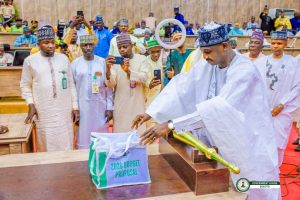
It is within this broader understanding of public finance that the 2026 budget proposal presented by Governor Ahmed Aliyu to the Sokoto State House of Assembly must be examined. Tagged the “Budget of Socio-Economic Expansion,” the proposal represents more than an administrative requirement, it reflects a deliberate governance choice, one that seeks to consolidate earlier gains while confronting persistent challenges. The governor’s address situates the budget within a continuum of gratitude, responsibility, and partnership, acknowledging both divine providence and institutional collaboration as pillars of governance.
A key indicator of good governance evident in the 2026 budget is the emphasis on performance and continuity. The administration’s reference to achieving over 60 per cent implementation of the 2025 budget is not incidental; it signals seriousness about credibility and execution. For citizens, budget implementation matters as much as budget size. Roads promised but not built, hospitals announced but not equipped, and allowances approved but unpaid erode public trust. By foregrounding implementation records, the government strengthens confidence that the 2026 proposals are not aspirational rhetoric but actionable commitments.
Equally important is the participatory foundation upon which the budget rests. The citizens’ town hall meetings held across the three senatorial zones and at the state level represent a notable departure from closed door fiscal planning. By drawing inputs from communities across all local governments and wards, the administration deepens democratic practice and reinforces the principle that citizens are not passive recipients of governance but active stakeholders. This inclusive approach enhances accountability, as people are more likely to monitor and defend a budget they helped shape.
From a structural standpoint, the 2026 budget demonstrates a development-oriented fiscal posture. With a total outlay of over ₦758 billion and approximately 72 per cent allocated to capital expenditure, the budget prioritises long-term investments over recurrent consumption. This choice carries profound implications for ordinary citizens. Capital spending translates into physical and social infrastructure that improves productivity, reduces the cost of living, and expands access to essential services. It is through such investments that governance leaves a lasting imprint on society.
Security occupies a central place in the budget, reflecting its role as the foundation upon which all other development efforts depend. Persistent insecurity in recent years has disrupted livelihoods, displaced communities, and slowed economic activity in parts of Sokoto State. Continued investment in security equipment, mobility, personnel welfare, and institutional capacity underscores the recognition that without safety, development initiatives cannot thrive. For citizens, improved security restores confidence, enables farming and trading, and reopens spaces for social and economic interaction. The steady progress being recorded in this area is gradually rebuilding public confidence.
The social sectors further reveal how the budget aligns governance priorities with human welfare. Health sector allocations exceeding international benchmarks signal a strong commitment to strengthening healthcare delivery. Completing and equipping hospitals, recruiting and training medical personnel, and improving emergency response systems directly influence life expectancy and quality of life. For families, particularly in rural areas, access to functional health facilities reduces preventable deaths and alleviates the burden of seeking care far from home.
Education’s prominence as the highest-funded sector reinforces the administration’s understanding of human capital as the bedrock of sustainable development. Investments in basic, technical, and tertiary education shape future productivity, innovation, and social cohesion. For parents and students, these allocations translate into opportunities for learning continuity, skills acquisition, and upward mobility, these are key ingredients for breaking cycles of poverty.
Investments in agriculture, water resources, and infrastructure further illustrate the budget’s people-focused orientation. Support for farmers through inputs and grain interventions enhances food security and rural incomes. The rehabilitation of waterworks and expansion of rural water supply projects address public health concerns and reduce domestic hardship. Road construction and transportation investments lower transaction costs, connect markets, and stimulate commerce. Though these interventions may appear technical on paper, in practice they redefine daily living conditions for thousands of households.
The budget’s attention to workers’ welfare and social protection also speaks to ethical governance. Clearing gratuity backlogs and ensuring regular funding for retirees correct long-standing injustices and restore dignity to those who served the state. For the workforce, such measures reinforce trust in public institutions and strengthen morale, which ultimately improves service delivery.
Perhaps most instructive is the balanced sectoral allocation underpinning the “Budget of Socio-Economic Expansion.” With economic and social sectors receiving the largest shares, the budget reflects an integrated development vision, one that recognises that growth without social investment is fragile, and social programmes without economic expansion are unsustainable. This balance is essential for building resilience and shared prosperity.
To sum up, the 2026 budget presented by Governor Ahmed Aliyu stands as a comprehensive governance instrument rather than a mere fiscal statement. Its emphasis on citizen participation, capital investment, security, and social development aligns with the principles of transparency, accountability, and responsiveness. If implemented with the same resolve with which it was crafted, the budget holds the capacity to translate policy into progress and statistics into improved living standards.
A budget, therefore, is far more than a collection of numbers. It is a roadmap that shapes how people live, work, and hope, from the safety of their communities to the quality of schools, hospitals, roads, and water systems they rely upon. When citizens are heard and their priorities reflected, budgeting becomes the heartbeat of good governance.
In this regard, Sokoto State’s 2026 Budget of Socio-Economic Expansion represents both an opportunity and a responsibility. It is an opportunity to deepen trust and development, and a responsibility to ensure that the promises embedded in its pages are faithfully delivered to the people.