


 By Sani Umar
Democracy is ultimately about good governance and the responsible deployment of public resources for the benefit of the people. Beyond the provision of infrastructure and public institutions, the success of any democratic government is also measured by its ability to respond to the immediate needs of citizens, protect their welfare and create opportunities for them to live decent and productive lives.
This is particularly important in periods of economic difficulty, when rising prices and declining purchasing power place additional pressure on households. For many ordinary families, food is the most immediate concern. When the prices of basic commodities rise beyond their reach, government intervention becomes necessary, not as a replacement for the market, but as a temporary mechanism for protecting vulnerable citizens and maintaining social stability.
It is against this backdrop that the decision of the Sokoto State Government under Governor Ahmed Aliyu to procure essential food commodities for sale to residents at subsidised prices should be understood. The policy is designed to cushion the effects of economic hardship and rising food prices while ensuring that rice, millet and maize remain available and affordable to a significant number of households across the state.
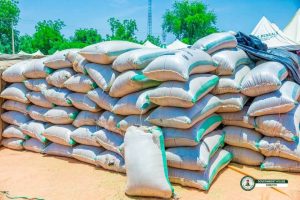
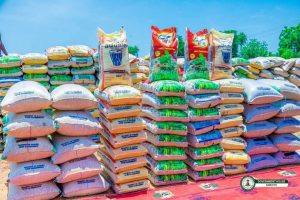
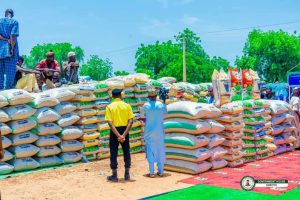
The scale of the intervention is significant. The state government procured 550 truckloads of rice, millet and maize at a total cost of ₦9.078 billion, including logistics, for distribution across the 23 local government areas. The commodities are not being distributed free of charge; rather, the government is absorbing a substantial portion of the cost so that residents can purchase them at prices considerably below the procurement cost.
Under the arrangement, a bag of rice procured at ₦53,375 is being sold to residents for ₦30,000, meaning that the state government is subsidising each bag by ₦23,375. Similarly, millet and maize procured at ₦43,625 per bag are being sold for ₦25,000, with the government absorbing ₦18,625 on each bag. These figures demonstrate that the intervention is not merely a symbolic gesture but a substantial financial commitment to household welfare.
The structure of the programme is also important because it demonstrates that government intervention in food security does not necessarily have to mean undermining farmers, traders or other participants in the food supply chain. By procuring the commodities from producers and the market, the government creates demand for agricultural produce while simultaneously making the commodities more affordable to consumers.
This creates a potentially beneficial chain of economic activity. Farmers and producers receive value for their produce, suppliers and contractors engaged in the procurement process earn legitimate income, transporters participate in the movement of commodities, while consumers benefit from lower prices. In this sense, the intervention goes beyond simply putting food on the table, it also injects resources into the local economy.
The decision to sell rather than give out the commodities entirely free of charge is equally significant. According to the Governor, the state expects to recover approximately ₦4.539 billion, representing 50 per cent of the total procurement cost, while the other ₦4.539 billion represents the subsidy borne by the government. The arrangement therefore combines social protection with a measure of cost recovery, making it possible for the intervention to reach more people than a completely free distribution model might allow.
Equitable distribution is another critical component of the programme. Each of the 23 local government areas is expected to receive between 12 and 16 truckloads, depending on population and size. Such an arrangement is intended to ensure that the intervention is not concentrated in the state capital or a few major communities, but reaches residents across the state.
Perhaps more importantly, Governor Aliyu has made it clear that the programme is not intended to compete with or destroy the activities of traders. This distinction is important. Government intervention in the food market must be carefully designed so that while consumers are protected from excessive prices, farmers, wholesalers, retailers and other market participants are not driven out of business. The objective should be to complement the market, not replace it.
The Governor’s appeal to traders to continue reducing the prices of essential commodities also reflects this understanding. Food security is not achieved through government procurement alone. It requires production, transportation, storage, marketing and affordability. This was aptly captured by the Minister of Budget and Economic Planning, Senator Abubakar Atiku Bagudu, who noted during the flag-off that food security goes beyond production to include distribution, marketing and affordability.
The Minister’s intervention also places the Sokoto initiative within the broader national economic context. International conflicts, energy and fertiliser price fluctuations, trade disruptions and domestic economic reforms can all affect food production and prices. These challenges require coordinated responses from the Federal, State and Local Governments, as well as farmers, traders and consumers.
The Sokoto initiative therefore represents one aspect of a broader strategy to address the immediate consequences of economic hardship while supporting the state’s longer term food security objectives. It complements other interventions under Governor Aliyu’s 9-Point SMART Agenda, particularly those relating to agriculture, economic empowerment and the welfare of citizens.
However, the effectiveness of such a programme ultimately depends on implementation. Subsidised commodities can only achieve their intended purpose if they actually reach the people for whom they are meant. This explains the Governor’s directive for transparency and accountability and his warning against diversion, manipulation and abuse. The monitoring mechanisms announced by the committee overseeing the exercise will consequently be as important as the procurement itself.
The intervention also presents an opportunity to strengthen public confidence in government. When citizens see public resources translated into tangible benefits, such as affordable food at a time when household budgets are under pressure, they are more likely to appreciate the practical meaning of governance. The real measure of the programme, therefore, will not only be the number of trucks procured or the amount of money spent, but the number of households that genuinely experience relief.
Ultimately, the subsidised sale of food items should be viewed as both a social intervention and an economic strategy. It provides immediate relief to households, supports the food market, creates demand for agricultural produce and demonstrates the willingness of government to deploy public resources in response to citizens’ needs. If implemented transparently and sustained alongside investments in agricultural production, storage, irrigation, rural infrastructure and market development, such interventions can contribute meaningfully to building a more resilient food system in Sokoto State.
For Governor Ahmed Aliyu’s administration, the challenge now is to ensure that the good intentions behind the programme are matched by effective implementation. With 550 truckloads of essential commodities and a substantial ₦4.539 billion government subsidy at stake, the people of Sokoto deserve a distribution process that is transparent, equitable and free from abuse. If that objective is achieved, the programme will stand not merely as a response to economic hardship, but as an example of how government can use its resources to cushion citizens while simultaneously strengthening the economic ecosystem that feeds them.