

By Ali Abare
Every election cycle in Nigeria brings its own theatre. As 2027 draws closer, the curtain has risen again, and the opposition is once more on stage, loud, agitated, and performing with great energy.
The African Democratic Congress, better known now as the ADC, has become the new vehicle for politicians who have spent years at the top of governance in Nigeria and are now positioning themselves as saviours of the same system they ran.
The story is familiar. The faces are even more familiar. And therein lies the problem.
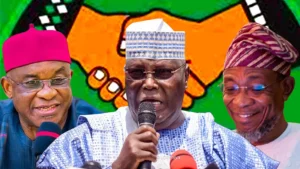
The ADC was formally adopted as the platform for the opposition coalition when former Vice President Atiku Abubakar, former Labour Party presidential candidate Peter Obi, former Senate President David Mark and other coalition leaders announced they would use the party to challenge President Bola Tinubu in 2027.
The rollout was dramatic, the crowd was large, and the cameras were many. But politics is not decided on unveiling days. It is decided in the quiet work of building genuine structures, earning trust, and answering hard questions. The ADC, barely months into its new life as a coalition platform, is already struggling to do any of those three things.
The party currently has no leadership recognised by INEC, a major blow for a party that has recently attracted heightened public attention as a possible coalition platform for opposition figures ahead of the 2027 elections.
The crisis did not come from outside. It came from within. A factional national chairman, Nafiu Gombe, took David Mark and others to court over the control of the party structure, and following a Court of Appeal ruling, INEC suspended recognition of both factions.
The opposition then turned its anger on INEC, accusing the electoral body of partisan conduct. But this requires scrutiny. INEC did not start this fight. Two factions of the same party went to court against each other, and the court issued an order. INEC obeyed the order. It is hard to see how obeying a court order makes an electoral body partisan.
Opposition politicians who are now up in arms against INEC had the opportunity to undertake electoral reforms when they served as leaders of the National Assembly and as members of government.
That observation deserves to sit with every Nigerian who is watching the current drama. David Mark was Senate President for eight consecutive years, from 2007 to 2015. During that period, he presided over a chamber that had every opportunity to strengthen Nigeria’s electoral laws and insulate the process from executive interference.
Atiku Abubakar served as Vice President for eight years under the PDP government. Peter Obi governed Anambra State for two terms. Rotimi Amaechi was governor of Rivers State, then served as Minister of Transportation under President Muhammadu Buhari. Rauf Aregbesola governed Osun State for eight years and was also a minister. Nasir el-Rufai governed Kaduna State for eight years. Aminu Tambuwal was Speaker of the House of Representatives and later governor of Sokoto State.
When you add up the years these men spent in power, you are looking at decades of collective governance stretching from Abuja down to the states. The Nigeria they are now asking the people to rescue from the APC is largely a Nigeria they built, managed, and in many cases profited from.
The fuel subsidy regime that swallowed trillions was not created by Tinubu. The forex policies that strangled the naira for years did not begin in 2023. The roads, the power sector, the bloated and inefficient federal bureaucracy — these are the products of administrations in which many of the ADC’s current leadership played principal roles.
It is against this backdrop that their current campaign must be assessed. They have taken to the streets, marched to INEC headquarters, and delivered fiery speeches about democracy and one-party rule. Peter Obi declared at the protest that Nigerians must say no to a one-party system, describing the demonstration as a defence of democracy itself.
These are noble words. But words from these particular mouths require more than emotion to be convincing. They require a reckoning with the past that none of them have offered.
The APC now commands the loyalty of the overwhelming majority of governors in this country. This did not happen by force. Governors are elected officials with their own political calculations and their own futures to protect.
They have been watching what the Tinubu administration’s fiscal reforms have done for the finances of their states, with the removal of the fuel subsidy and the unification of the exchange rate freeing up resources that governors of all stripes had long demanded.
When a governor moves from the PDP to the APC, it is not because he received a phone call in the night. It is because he has looked at the numbers and made a decision. The opposition’s failure to reckon with this reality is itself a sign of how far removed their leadership is from the actual concerns of governance.
Even if the ADC eventually scales through the high walls of its self-inflicted woes, the ambitions of its members remain a potential danger for uniting the opposition. Atiku, Peter Obi, Rotimi Amaechi and Rabiu Kwankwaso are already said to be in competition over who will carry the presidential ticket, and the fallout of that contest may open yet another window for disgruntled members to return to the ruling party.
This is the nature of a coalition held together not by ideology or shared vision but by the single desire to remove an incumbent. Once the question of who benefits from removal comes to the table, every crack in the arrangement becomes a canyon.
Sources close to the developments reveal that key opposition figures including Atiku, Obi and Kwankwaso are already said to be weighing the possibility of abandoning the ADC for alternative platforms, given that political insiders warn the crisis could cripple the party’s ability to participate in the 2027 elections.
A coalition that is already shopping for a replacement platform before it has even produced a candidate is not a coalition in any serious sense. It is a gathering of powerful individuals waiting to see which arrangement best serves each of them personally.
Nigeria has seen this story before. In 2019 and again in 2023, the opposition went into elections divided, then united just enough to lose, then fell apart immediately after.
The ADC in its current form is not a departure from that pattern. It is a continuation of it with new branding. The men at its head are not new voices with fresh ideas about how to move Nigeria forward.
They are established figures whose records are in the public domain, and whose return to the corridors of power would, for most Nigerians, represent a step backwards rather than a step forward.
President Tinubu’s administration has taken painful but necessary decisions that previous governments postponed at great cost to the country.
The opposition has every right to contest 2027. Democracy requires that the ruling party face genuine competition. But the ADC as presently constituted, fighting over its own leadership in court while blaming the court’s consequences on the government, is not that genuine competition.
It is noise dressed up as purpose, and most Nigerians, when the time comes, will know the difference.
Abare is a Muck Rack journalist. He writes from Lafia, Nasarawa State.