

By Sani Umar
Ramadan is one of the most sacred months in Islam, a period when Muslims abstain from food, drink and marital relations from dawn to sunset for thirty days in obedience to Allah. Beyond physical deprivation, it is a season of deep spiritual cleansing, repentance and renewed devotion to the Almighty. Fasting teaches perseverance, moderation and humility, reminding both the wealthy and the poor that all human beings stand equal before their Creator. It nurtures piety and compels the faithful to show compassion, generosity and love to the less privileged in society.
The essence of fasting is not merely to endure hunger but to internalise the pain of those who live daily with deprivation. When a wealthy person feels the pangs of hunger, even for a few hours, it becomes easier to empathise with the orphan, the widow, the internally displaced and the physically challenged who struggle to secure a single meal. Islam therefore strongly enjoins believers to feed their fasting brethren, support the needy and extend kindness generously, especially during Ramadan when the rewards of good deeds are multiplied.
In Nigeria, particularly in the predominantly Muslim northern and some Southern states, the observance of Ramadan is both spiritual and communal. Governments, organisations and individuals leverage the month to expand acts of charity. In Sokoto, this culture of organised compassion has found expression in structured Ramadan feeding centres that provide daily iftar meals to thousands of residents. These centres have become lifelines for the poor, travellers caught away from home at sunset, orphans, widows and workers whose earnings can barely sustain their families amid prevailing economic hardship.
The Ramadan feeding programme in Sokoto has a long history, dating back 19 years to the administration of Aliyu Magatakarda Wamakko, and it has been sustained and expanded over time. Under the leadership of Ahmed Aliyu, the initiative has been reorganised to improve efficiency, transparency and reach. In 2026, the state government approved ₦1 billion for 170 feeding centres, each catering for 200 persons daily, amounting to 34,000 plates of food served every evening at iftar. This scale of intervention is not symbolic, it is substantial, structured and measurable.
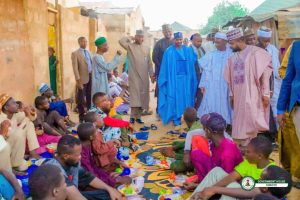
During inspection visits to centres such as Clapperton Centre, Lodge Road Centre, Gidan Dallatu Centre and the Specialist Hospital Centre, Governor Aliyu expressed satisfaction with the improved quality and quantity of food served. His personal assessment underscores accountability in the management of public funds. The emphasis on nutritious meals reflects an understanding that feeding the fasting is not about mere survival but about preserving dignity and health during a spiritually demanding month.
The justification for allocating public funds to these centres becomes clearer when viewed against the socio-economic realities facing many citizens. Persistent security challenges and environmental disasters, including devastating floods that destroyed farmlands and livelihoods, have displaced thousands and increased poverty levels.
In response, the Sokoto State Government extended its Ramadan intervention to 35,351 Internally Displaced Persons and physically challenged individuals. Each beneficiary received essential food items, clothing materials and, in some cases, cash support. Such assistance ensures that even the most vulnerable can observe Ramadan with dignity rather than despair.
Public spending on feeding centres is not wasteful expenditure; it is a strategic social investment. First, it cushions the effects of inflation and economic hardship by reducing the food burden on struggling families. Second, it promotes social harmony by narrowing the visible gap between the rich and the poor during a month that symbolises equality. Third, it strengthens communal bonds as people gather peacefully to break their fast together. In a society grappling with insecurity, any initiative that fosters unity and shared humanity contributes indirectly to stability.
Moreover, these centres generate temporary economic activities. Local farmers, food vendors, caterers and transporters benefit from the procurement and distribution processes. Thus, the funds circulate within the local economy, providing secondary financial relief beyond the direct beneficiaries of the meals.
Critics may question the scale of funding, yet the moral and constitutional responsibility of government includes safeguarding the welfare of its citizens. Ramadan feeding programmes align with this duty by targeting the most vulnerable at a time when their needs are heightened. Transparency, monitoring and continuous improvement remain essential, but the existence of the programme itself reflects responsive leadership rooted in cultural and religious values.
Islam teaches that whoever feeds a fasting person will receive a reward equal to that of the one who fasted, without diminishing the latter’s reward. When government institutions institutionalise this principle, they transform individual charity into collective compassion. At the same time, clerics and community leaders continue to encourage wealthy individuals and organisations to establish supplementary feeding centres, reinforcing the shared responsibility of society.
Ultimately, Ramadan is about spiritual elevation through sacrifice, empathy and generosity. Feeding centres embody these virtues in practical form. They ensure that hunger does not overshadow worship, that poverty does not silence devotion, and that hope is restored to those burdened by hardship. In sustaining and expanding these programmes, Sokoto State affirms that governance and compassion can walk hand in hand, especially in a month devoted to mercy, equality and the pursuit of eternal reward.